
Why the knife matters as much as the cut
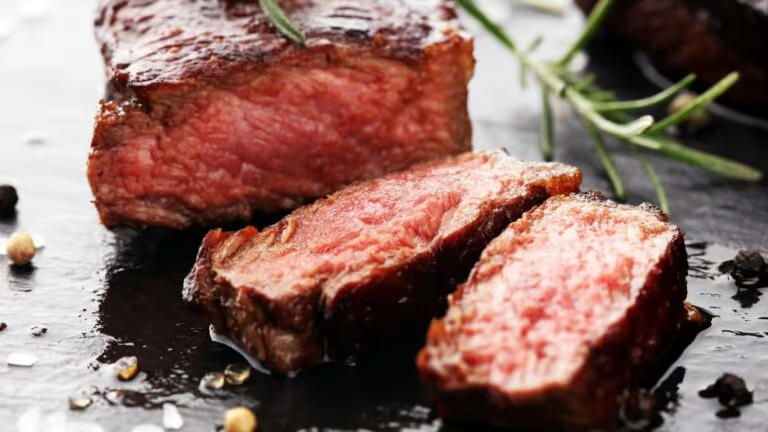
A steak that has spent four to six weeks dry-ageing has lost a good share of its water, and what’s left is concentrated flavour and soft, relaxed muscle. Drag a dull blade through it and you undo some of that work. The knife crushes the fibres instead of cutting them, and the juice that should stay in each mouthful ends up pooling on the plate.
That’s the case for taking steak knives seriously. The cut, the ageing and the cooking all happen before the plate reaches the table. The last step belongs to the knife.
Serrated or straight edge: what our butchers use and why
In the butchery, the knives are straight. Boning and breaking down a primal calls for a smooth edge that can follow a seam of fat or slide along a bone, and a butcher hones that edge many times a shift.
The dining table is a different job. A steak knife lives on ceramic plates, goes through a wash after every service and gets used by people who will never hone it. Under those conditions a straight edge goes dull quickly, and a dull straight edge tears the meat far worse than a sharp serrated one.
So for the table, we recommend serrated steak knives. What matters then is the type of serration:
- Fine, scalloped serrations have small, rounded teeth set close together. They glide through a charred crust and slice the meat underneath cleanly.
- Coarse, pointed teeth, like a bread knife, rip at the surface and leave a ragged cut.
A straight edge kept razor sharp will always give the cleanest slice. For most homes, though, a well-made fine serrated knife cuts better on an ordinary Tuesday, and keeps doing it for years with almost no maintenance.
What to look for in a steak knife
Blade steel. Look for a named stainless steel. X50CrMoV15 is the grade used by many German knife makers. Its chromium content resists rust and staining, and it holds an edge while staying tough enough not to chip. Hardness is usually listed on the Rockwell scale. Around 56 to 58 HRC is a good balance for a knife that gets used daily.
Full tang. The tang is the part of the blade that runs into the handle. A full tang runs the whole length, so the handle is fixed around solid steel. Knives with a short tang are the ones that work loose and start to rattle after a few years.
Weight and balance. A good steak knife has enough weight to do the cutting for you. You should be able to draw it through a steak without leaning on it. Pick it up and rest it on one finger where the blade meets the handle. If it tips sharply either way, it’ll feel awkward at the table.
Handle material. Timber looks beautiful but needs care, and it can crack if it’s soaked or put through a dishwasher. Resin and composite handles are tougher and easier to live with. Whatever the material, there should be no gaps where water can get in.
Those four points are a fair test of the best steak knives in Australia, whatever you’re prepared to spend.
How to cut your steak
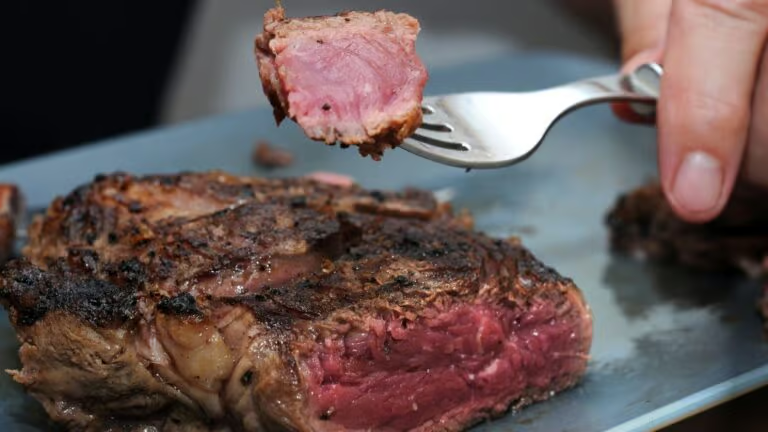
Slice against the grain. Look for the long lines of muscle fibre running along the steak and cut across them, so each piece holds short fibres that come apart easily when you chew.
Use long strokes. Let the knife travel its full length in one or two draws. Sawing back and forth in short bursts mashes the meat, even with a good blade.
Adjust the slice to the cut:
- Bavette has a coarse, open grain that runs clearly in one direction. It’s full of flavour but can be chewy if cut the wrong way, so slice it thinly across the grain. Our Cut of the Month post on bavette covers it in more detail.
- Eye fillet has a fine, tight grain and very little connective tissue. It’s tender enough to cut into thicker pieces, and you’ll keep more juice in each one. There’s more on it in our eye fillet Cut of the Month post.
How to care for steak knives
Hand wash only. At home, wash steak knives in warm soapy water and dry them straight away. Our own knives are built to survive a commercial dishwasher, because a restaurant has no other option. A home dishwasher still shortens the life of any edge. The heat, harsh detergent and other cutlery knocking against the blade all take their toll, and wooden handles can split.
Honing vs sharpening. Honing realigns an edge that has rolled over in use. Sharpening grinds away metal to form a new edge. A straight-edge knife needs honing often, ideally before each use, and sharpening once or twice a year.
Serrated knives need far less. Honing doesn’t suit serrations, and for home use one sharpening a year or less is usually enough. To sharpen steak knives with a serrated edge, run a thin tapered ceramic rod through each scallop on the bevelled side, then take one light pass along the flat side to remove the burr. If that sounds fiddly, a professional sharpener can do the job.
Storage. Keep knives in a block, a knife roll or the box they came in. Loose in a drawer, the edges knock against other metal and blunt quickly.
The knife on your table at Macelleria
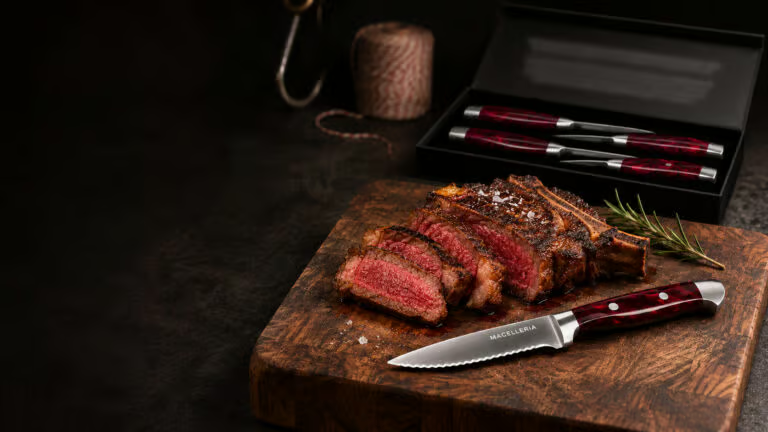
The steak knife you’ll use at Macelleria was designed for us and carries no outside brand. It’s made from X50CrMoV15 stainless steel, the German grade described above, hardened to 56 to 58 HRC for a balance of sharpness, edge retention and toughness.
We chose it for commercial durability first. A steakhouse knife goes through hundreds of services and the dishwasher after every one, so the blade is passivated against rust and staining, and the dark brown resin handle is heat-resistant and fixed around a full tang. We’ve all seen restaurant knives with handles that loosen and rattle over time, and we built ours to avoid that.
The edge has small, tight serrations with a rounded scallop, the fine style we recommend above. The blade has a satin finish, the knife weighs about 180 g, and the Macelleria logo is laser-etched on both sides.
The gift: good knives and a steak dinner to use them on
The same knife is sold by itself for $29 or in a boxed set of four for $99. Buy one at the counter or order a set online.
For a steak lover, pair the knives with a Macelleria gift card. They can spend it on a raw cut from the butcher’s counter to cook at home with their new knives, or on a steak dinner across the road from Bondi Beach. We’re walk-in only, so there’s no booking needed. They can come in whenever we’re open.
Questions about steak knives
Are serrated or straight-edge steak knives better?
For most people, serrated. A fine, scalloped serrated edge cuts cleanly through a steak and stays sharp for years with little care. A straight edge can cut slightly cleaner, but only if it’s honed often.
How often should you sharpen steak knives?
For home use, sharpen a serrated knife about once a year or when it starts to drag. A straight-edge knife needs honing before each use and sharpening once or twice a year.
Should steak knives go in the dishwasher?
Not at home. Heat and detergent dull the edge and crack wooden handles. Hand wash and dry straight away.
What is a good gift for a steak lover in Sydney?
A quality steak knife set paired with a Macelleria Bondi gift card. The recipient picks a cut at the butcher’s counter and uses the knives at home.
Do I need a booking to use a Macelleria Bondi gift card?
No. Macelleria Bondi is walk-in only. Bring the card any time the restaurant is open.